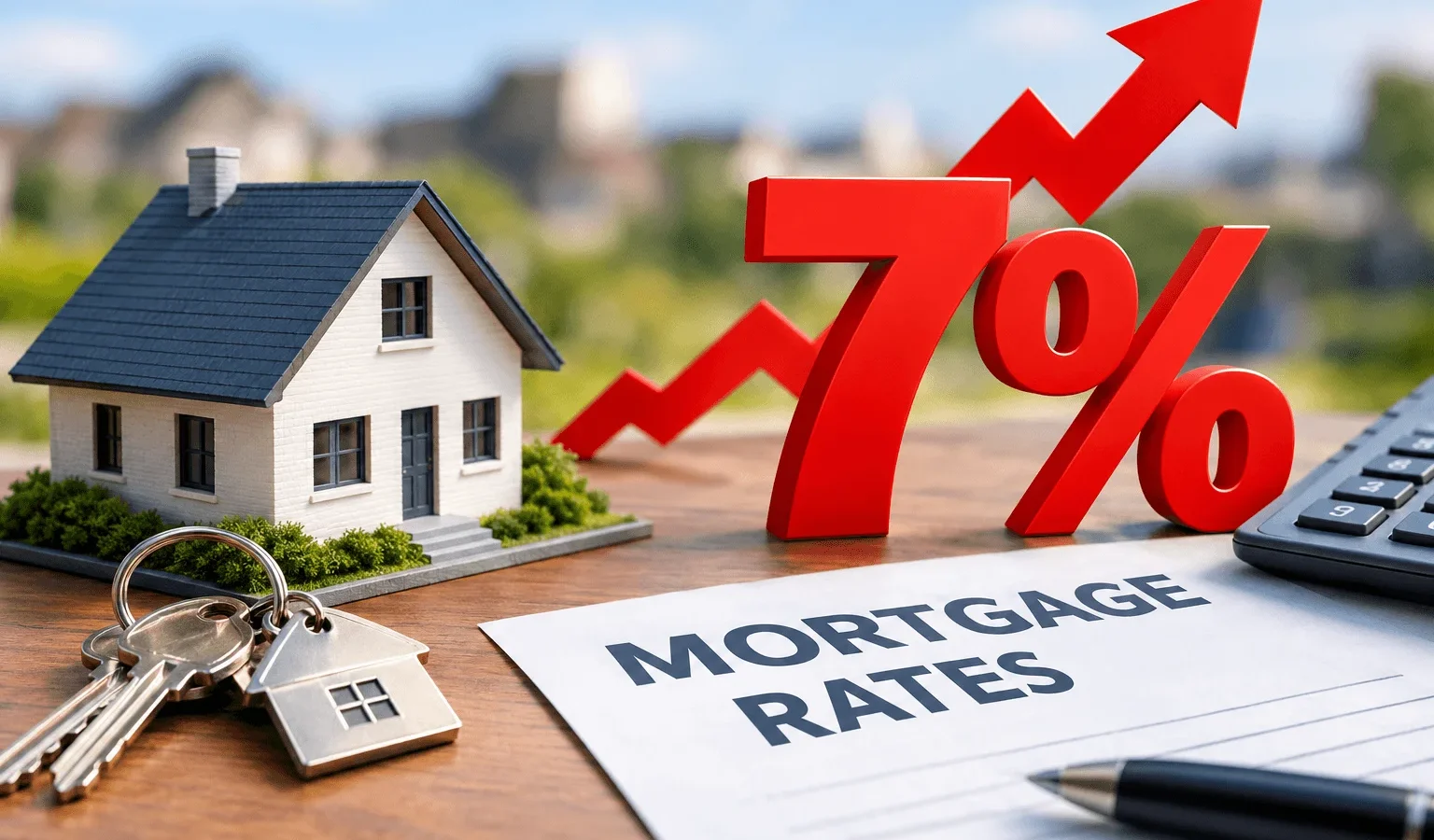
Mortgage Rates Are Back Above 7%: How Much House Can You Still Afford?
The average 30-year mortgage rate has climbed back above 7%. See how higher rates change monthly payments, buying power, PITI, debt-to-income calculations, down payments, and the decision to buy, wait, or negotiate.
Editorial disclosure: Mortgage rates, lender qualification standards, taxes, insurance costs, PMI premiums, closing costs and loan terms vary by borrower and location. Verify current loan pricing and underwriting requirements directly with your lender before making a home-purchase decision.
Financial disclaimer: This article is educational and does not constitute mortgage, financial, tax or legal advice.
Key Takeaways
- Freddie Mac reported an average 7.03% rate for a 30-year fixed mortgage on September 24, 2026, up from 6.95% one week earlier.
- With a fixed $2,500 monthly principal-and-interest budget, moving from 6% to 7% reduces supported loan principal by about $41,200.
- With 10% down, that translates to roughly $45,800 less home-buying power.
- Your real housing cost is not just principal and interest. Property taxes, homeowners insurance, mortgage insurance and HOA dues can materially increase the payment used for qualification.
- Fannie Mae’s manually underwritten loans generally cap total DTI at 36%, with certain qualified borrowers permitted up to 45%; Desktop Underwriter casefiles can permit higher ratios under applicable rules.
- If you have variable overtime, shift differentials or bonus income, lender qualification rules may average historical earnings rather than simply using your strongest recent paycheck.
Mortgage Rates Are Back Above 7%
According to Freddie Mac’s Primary Mortgage Market Survey, the average 30-year fixed mortgage reached 7.03% on September 24, 2026, up from 6.95% one week earlier. The average 15-year fixed mortgage was 6.42%.
For buyers who built their home-shopping budget when mortgage rates were closer to 6%, crossing back above 7% can materially change the numbers.
A higher mortgage rate raises the monthly principal-and-interest payment on the same loan amount. If you insist on keeping the monthly payment unchanged, the amount you can borrow falls instead.
What this means for buyers: If your pre-approval or home-search ceiling was calculated using a materially lower rate, rerun the numbers before submitting an offer. Your lender may also need to update the qualifying payment used in your debt-to-income calculation.
The Math: How 6%, 7% and 7.5% Reduce Purchasing Power
Mortgage qualification is based partly on whether your required monthly obligations fit your documented income. Higher rates increase the payment attached to a given loan balance, so a fixed monthly housing budget supports less principal.
For manually underwritten Fannie Mae loans, the standard maximum total debt-to-income ratio is generally 36%, although qualified borrowers meeting additional credit and reserve standards may reach 45%. Loans evaluated through Fannie Mae’s Desktop Underwriter can permit total DTI ratios up to 50% under applicable eligibility rules.
For your own budget, however, the lender’s maximum should not automatically become your spending target.
Assume you want to dedicate exactly $2,500 per month to principal and interest on a 30-year fixed mortgage. The supported loan amount changes substantially as the rate rises:
| 30-Year Fixed Rate | Maximum Loan Supported by $2,500 P&I | 10% Down Payment | Approx. Purchase Price | Total Interest Over 30 Years |
|---|---|---|---|---|
| 6.00% | $416,970 | $46,330 | $463,300 | $483,030 |
| 7.00% | $375,765 | $41,750 | $417,515 | $524,235 |
| 7.50% | $357,545 | $39,725 | $397,270 | $542,455 |
The takeaway: Moving from 6.00% to 7.00% reduces the loan principal supported by a $2,500 payment by about $41,200. With a 10% down payment, the corresponding purchase-price ceiling falls by roughly $45,800.
The same effect can be viewed from the opposite direction. If you borrow the same amount regardless of rate, the monthly payment rises. On a mortgage in the roughly $375,000 range, moving from 6% to 7% adds about $240 per month to principal and interest.
Important: These examples isolate principal and interest. Your actual housing payment can be substantially higher after property taxes, homeowners insurance, mortgage insurance and HOA dues are included.
Factor the True Payment: PITI + PMI, Not Just the Note Rate
Home-search portals often emphasize estimated principal and interest. Your real monthly housing obligation can include several additional costs.
1. Principal and Interest
This is the contractual mortgage payment created by your loan balance, interest rate and amortization term.
2. Property Taxes
Property taxes vary dramatically by state, county, municipality and property value. Your lender generally includes the required monthly tax obligation when calculating the housing payment used for underwriting.
3. Homeowners Insurance
Insurance premiums depend on the home, location, replacement cost, deductible, claim history, weather exposure and other underwriting factors. Get an insurance quote on a property before assuming a generic monthly number.
4. Private Mortgage Insurance
On conventional loans, borrowers making a down payment below 20% will typically need mortgage insurance. PMI protects the lender rather than the homeowner and increases the cost of the mortgage.
5. HOA or Condo Dues
Required homeowners-association or condominium assessments also affect monthly affordability and can be included in the obligations used to calculate DTI.
Affordability rule: Do not ask, “Can I afford the mortgage payment?” Ask, “Can I afford the complete housing payment plus repairs, maintenance and the rest of my financial goals?”
Audit Your Numbers With the Beelinger Mortgage Calculator
Rather than relying on a listing site’s simplified monthly estimate, use the Beelinger Mortgage Calculator to model the complete payment.
Use it to test:
- Principal and interest: See how rate and loan amount affect the required monthly payment.
- Property taxes and homeowners insurance: Add realistic local estimates instead of relying on a national average.
- PMI: Model the additional cost when your conventional down payment is below 20%.
- HOA dues: Include mandatory association payments in your housing budget.
- Rate changes: Compare the same home at 6.5%, 7.0% and 7.5%.
- Down-payment changes: See how 5%, 10% and 20% down alter the financed amount and monthly payment.
Know the full payment before you tour the next house
Stress-test the price, mortgage rate, taxes, insurance, down payment and PMI before a lender or real-estate listing defines affordability for you.
Beware the “Best-Month Income” Qualification Trap
Variable income deserves special attention for workers whose pay includes overtime, shift differentials, bonuses, commissions or other fluctuating compensation.
Fannie Mae’s current guidance says a two-year history of bonus, commission, overtime and tip income is recommended, although income received for a shorter period—generally no less than 12 months—may sometimes be considered when positive factors support it. Lenders analyze the historical trend and compare current year-to-date earnings with previous periods.
That means a few unusually strong paychecks do not automatically establish sustainable qualifying income.
Base Pay vs. Variable Pay
For your own household budget, consider whether the mortgage remains affordable on dependable base compensation rather than assuming every overtime shift, incentive payment or bonus will continue indefinitely.
Treat Variable Income as a Buffer
If your normal earnings cover the housing payment, additional shift differentials, bonuses or overtime can be directed toward:
- Home-maintenance sinking funds.
- Emergency savings.
- Extra mortgage principal.
- Retirement contributions.
- Large future expenses.
Do Not Empty Your Savings at Closing
A lender’s approval tells you whether the mortgage satisfies its underwriting standards. It does not mean spending every available dollar on the down payment and closing costs is financially comfortable.
Homeowner reality check: Closing day does not end the expenses. Moving, appliances, repairs, insurance deductibles, HVAC failures, plumbing problems and property-tax changes can arrive soon after you receive the keys.
Strategic Decision Framework: Buy, Wait or Renegotiate?
A 7% mortgage rate does not produce the same answer for every buyer. The decision depends on your current housing need, cash reserves, debt load, local inventory, seller flexibility and how comfortably the full payment fits your income.
Renegotiate
Best when: The property works but the upfront economics do not.
Explore seller concessions, closing-cost credits, price reductions or a temporary rate buydown.
Wait
Best when: Buying would consume reserves or leave debt too tight.
Build cash, improve credit, reduce expensive debt and strengthen the future down payment.
Buy
Best when: The payment works today without depending on a future refinance.
Buy below the maximum if needed and preserve liquidity after closing.
Scenario 1: Negotiate Seller Concessions or a 2-1 Buydown
A seller concession can sometimes be applied toward closing costs or a temporary interest-rate buydown, subject to loan-program rules and lender approval.
With a temporary 2-1 buydown and a permanent note rate of 7.03%, the payment can be calculated using an effective rate approximately two percentage points lower during Year 1 and one percentage point lower during Year 2 before returning to the full contractual rate in Year 3.
- Year 1 payment basis: approximately 5.03%.
- Year 2 payment basis: approximately 6.03%.
- Year 3 onward: 7.03% contractual note rate.
Do not mistake a temporary buydown for permanent affordability. Your payment eventually resets to the full note-rate payment. Qualification requirements also depend on the loan program and lender; do not assume the temporary first-year payment is the payment used to qualify you.
Scenario 2: Delay and Strengthen Your Balance Sheet
Waiting can make sense if buying would drain emergency savings, leave high-interest debt outstanding or push the housing payment uncomfortably close to your maximum cash flow.
A delay can be used intentionally to:
- Increase your down payment.
- Build a larger post-closing reserve.
- Reduce credit-card balances.
- Pay off monthly installment debt.
- Improve credit before applying again.
- Strengthen documented income history.
Money intended for a near-term home purchase generally should not depend on stock-market returns. A competitive FDIC-insured savings account, insured money market deposit account or other appropriately liquid cash vehicle can be more suitable for near-term funds.
Scenario 3: Buy Below Your Pre-Approval Maximum
A lender’s maximum pre-approval is an underwriting ceiling, not a spending recommendation.
If you need to buy now because of relocation, family changes, lease timing or another genuine housing need, deliberately shopping below your maximum can preserve monthly flexibility.
Most importantly, do not base today’s purchase on the assumption that you can refinance later.
Refinancing rule: Treat a future refinance as a potential upside—not as the mechanism that makes today’s payment affordable. Future rates, property value, equity, qualification and refinancing costs are uncertain.
4 Action Items Before Making an Offer
1. Audit the Complete Monthly Payment
Enter the target purchase price, down payment, interest rate, taxes, insurance, PMI and HOA costs into the Beelinger Mortgage Calculator.
Then test whether the payment still works if one variable-income source temporarily disappears.
2. Compare Multiple Loan Estimates
Do not assume the first lender has the strongest combination of rate and fees. Compare offers from multiple lenders using the same loan amount, down payment and points structure so the comparison is meaningful.
Mortgage credit inquiries made while rate shopping are commonly grouped for credit-scoring purposes when they occur within the applicable shopping window, although the exact window depends on the scoring model.
3. Evaluate Discount Points by Break-Even Period
Discount points exchange additional upfront cash for a lower mortgage rate. The Consumer Financial Protection Bureau recommends comparing the upfront cost with the monthly savings across realistic time horizons.
A simple starting calculation is:
Break-even months = upfront cost of points ÷ monthly payment savings
For example, if points cost $4,000 and reduce your payment by $80 per month:
$4,000 ÷ $80 = 50 months
You would need to keep that mortgage for a little over four years before the cumulative monthly savings equal the upfront cost.
If you sell or refinance before reaching the break-even point, the points may not produce the intended savings.
4. Preserve Liquid Cash After Closing
Do not direct every available dollar toward the down payment simply to reduce the payment. Compare the benefit of additional equity with the need for an accessible post-closing cash reserve.
Homeownership introduces expenses renters may not have previously carried, including appliance replacement, repairs, insurance deductibles, yard maintenance and structural problems.
Need money soon? Build a realistic plan.
If a mortgage payment, down payment or current debt load is putting pressure on your cash flow, use Beelinger Money Coach to think through the numbers and identify the next practical move.
Frequently Asked Questions
What is the average 30-year mortgage rate right now?
Freddie Mac reported that the average 30-year fixed-rate mortgage was 7.03% as of September 24, 2026, up from 6.95% the previous week. Individual borrowers may receive higher or lower quotes depending on credit, down payment, loan type, points, property and lender pricing.
How much buying power do you lose when mortgage rates rise from 6% to 7%?
With a fixed $2,500 monthly principal-and-interest budget on a 30-year mortgage, a 6% rate supports roughly $416,970 of principal while 7% supports about $375,765. That is approximately $41,200 less borrowing capacity. With 10% down, the corresponding home-price difference is roughly $45,800.
Does mortgage affordability include taxes and insurance?
Yes. Your realistic housing payment should include principal, interest, property taxes and homeowners insurance. Mortgage insurance and HOA dues may also apply. Lenders incorporate applicable housing obligations when calculating mortgage qualification.
Do I automatically need PMI if I put less than 20% down?
Conventional borrowers putting less than 20% down typically need private mortgage insurance. Other loan types, including FHA and USDA mortgages, have different mortgage-insurance structures.
Should I wait to buy until mortgage rates fall?
There is no guarantee that mortgage rates will fall on a timetable that matches your housing needs. A more useful test is whether the complete payment is affordable today, whether you can preserve adequate cash reserves after closing, and whether the property and price fit your longer-term plans without relying on a future refinance.
Are mortgage discount points worth paying?
They can be when the lower monthly payment saves more over the period you expect to keep the mortgage than the points cost upfront. Compare the break-even period with how long you realistically expect to keep the loan.
Can overtime and shift differential count toward mortgage qualification?
Potentially. Fannie Mae guidelines recommend a two-year history for bonus, overtime, commission and tip income, although shorter histories of at least 12 months may sometimes qualify when positive factors support them. Lenders analyze whether the income is stable and likely to continue rather than simply using the highest recent paycheck.
Sources
-
Freddie Mac Primary Mortgage Market Survey — Current Mortgage Rates
-
Freddie Mac PMMS Archive — September 2026 Weekly Mortgage Rates
-
Fannie Mae Selling Guide — Debt-to-Income Ratios
-
Fannie Mae Selling Guide — Bonus, Commission, Overtime and Tip Income
-
Fannie Mae Selling Guide — Standards for Employment-Related Income
-
Consumer Financial Protection Bureau — What Is Private Mortgage Insurance?
-
Consumer Financial Protection Bureau — Mortgage Insurance
-
Consumer Financial Protection Bureau — Discount Points and Lender Credits
-
Consumer Financial Protection Bureau — Discount Point Break-Even Considerations
-
Beelinger Mortgage Calculator
-
Beelinger Money Coach
Mortgage-rate data were verified against Freddie Mac’s September 24, 2026 Primary Mortgage Market Survey. Underwriting references were reviewed against current Fannie Mae and Consumer Financial Protection Bureau guidance. Mortgage pricing and qualification requirements can change and vary by lender, borrower and loan program.
More from Beelinger
-
money-brief How Much Should You Put in Your 401(k)
How Much Should You Put in Your 401(k)? Start With the Match, Not the 15% Rule A sustainable…
-
money-brief Can You Claim Part of the $167.5M Visa and Mastercard ATM Surcharge Settlement?
Paid a Fee at a Nonbank ATM? Check Whether You Can Claim Part of the $167.5 Million Settlement…
-
budgeting 5 Ways to Make It Without a Steady Paycheck
5 Ways to Make an Irregular Income Feel More Predictable Variable income does not have to mean a…
-
credit cards What the Freedom Flex Update Means: No Phone Insurance, Zero FX
Chase Freedom Flex® Benefit Shake-Up: Cell Phone Protection Dropped, Foreign Fees Eliminated Chase Freedom Flex ended its cell…