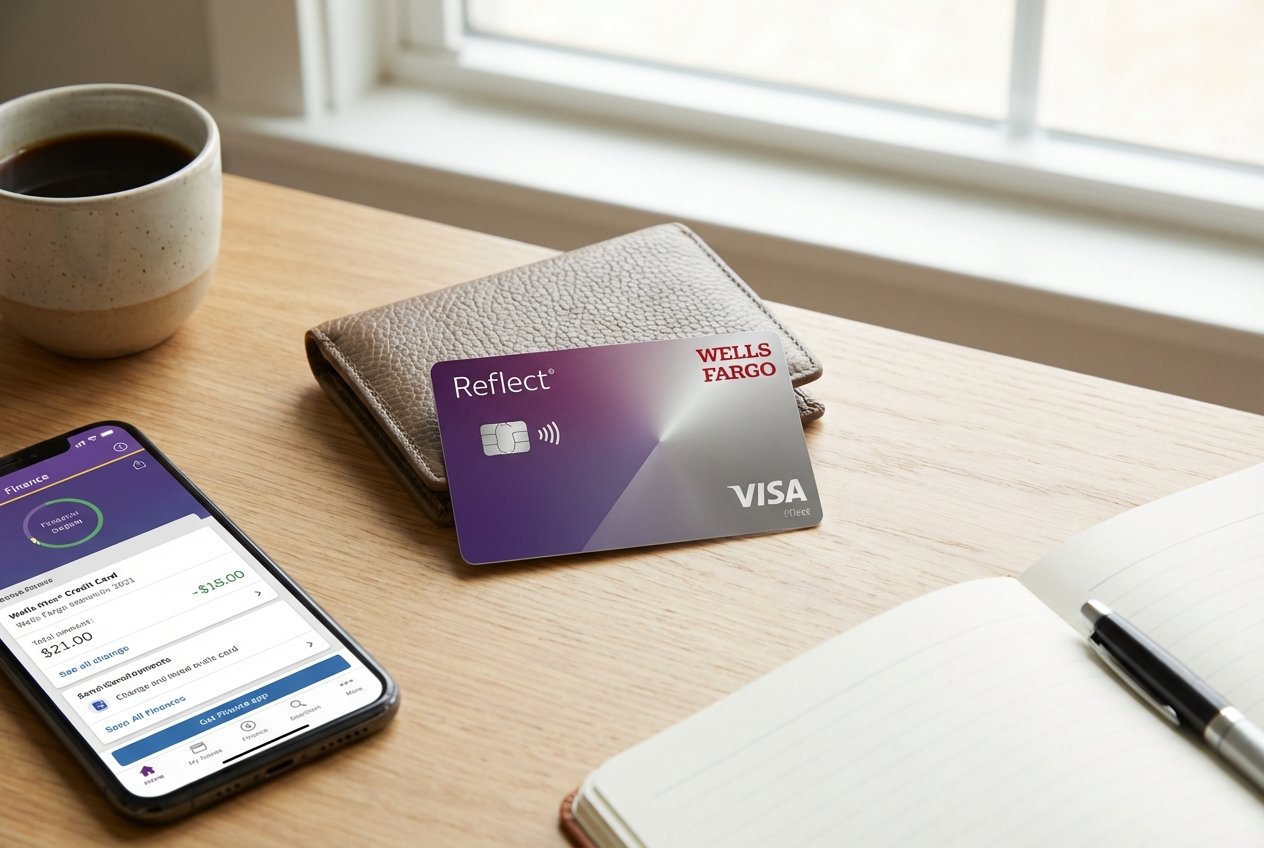
Wells Fargo Reflect® Card Review 2026: The Ultimate 21-Month Shield Against High-Interest Debt?
The Wells Fargo Reflect® Card offers 0% intro APR for 21 months on purchases and qualifying balance transfers, making it one of the longest interest-free financing tools available with no annual fee.
Credit card disclosure: Credit-card offers, APRs, fees, eligibility rules and benefits can change. Verify the current application terms directly with Wells Fargo before applying.
Debt warning: A balance-transfer card can reduce interest costs, but it does not eliminate debt. A successful strategy requires stopping new revolving debt and paying the transferred balance before the promotional APR expires.
Key Takeaways
- The Wells Fargo Reflect® Card currently offers 0% intro APR for 21 months from account opening on purchases and qualifying balance transfers.
- Balance-transfer requests must be made within 120 days of account opening to qualify for the introductory APR.
- The balance-transfer fee is 5% of each transfer, with a $5 minimum.
- The annual fee is $0.
- After the promotional period, the current variable APR is 17.49%, 23.99%, or 28.24%, depending on creditworthiness.
- The card earns no standard cash back, points, or miles.
- Eligible cardholders can receive up to $600 per approved cell-phone protection claim, subject to a $25 deductible and benefit terms.
- The card charges a 3% foreign transaction fee, making it a poor choice for overseas spending.
1. Introduction & The Bottom Line
The Wells Fargo Reflect® Card is one of the strongest no-annual-fee tools for reducing interest costs rather than earning rewards.
Its defining feature is a 0% introductory APR for 21 months from account opening on purchases and qualifying balance transfers. That gives disciplined borrowers nearly two years to eliminate transferred debt or finance a planned necessary expense without interest.
Reflect is not designed to be a permanent everyday rewards card. It is better understood as a financial-reset tool.
The ideal applicant already knows how much debt needs to be moved, understands the transfer fee, and has a monthly payoff target that clears the entire balance before the standard APR begins.
Best fit: Borrowers consolidating expensive revolving debt, households financing a planned large purchase, or consumers who need an unusually long 0% APR runway.
Weak fit: Rewards seekers, international travelers, or anyone likely to continue adding new credit-card debt after the transfer.
For borrowers facing credit-card APRs above 20%, the economics can be compelling. A 5% transfer fee is significant, but it can still be far less expensive than another year or two of high-interest revolving debt.
Bottom line: Reflect works when you treat the 21-month window as a deadline rather than extra spending capacity.
2. Card Essentials at a Glance
| Feature | Wells Fargo Reflect® Card |
|---|---|
| Annual Fee | $0 |
| Intro APR on Purchases | 0% for 21 months from account opening |
| Intro APR on Balance Transfers | 0% for 21 months from account opening on qualifying transfers |
| Transfer Deadline | Balance-transfer request must be made within the first 120 days |
| Balance Transfer Fee | 5% of each transfer, $5 minimum |
| Post-Promotion APR | 17.49%, 23.99%, or 28.24% variable APR, based on creditworthiness |
| Cell Phone Protection | Up to $600 per approved claim; $25 deductible; maximum two paid claims per 12-month period |
| Foreign Transaction Fee | 3% of each transaction converted to U.S. dollars |
| Rewards | No ongoing cash-back, points, or miles program |
Critical timing rule: The 21-month promotional period begins when the account is opened—not when you make the transfer. Waiting several months to transfer debt reduces the amount of 0% time remaining even if the transfer still qualifies.
3. What Makes Wells Fargo Reflect® Stand Out?
The Dual 21-Month Runway
Reflect’s most important advantage is the same 21-month 0% introductory APR period on both purchases and qualifying balance transfers.
That matters because many competing balance-transfer cards provide a long promotional period on transferred debt while offering a shorter interest-free period on purchases.
Reflect gives you one timeline.
Existing Debt
Transfer qualifying high-interest balances within the first 120 days.
Planned Purchase
Eligible new purchases also receive the 21-month introductory APR.
One Deadline
Build the payoff around the promotional expiration date from account opening.
This can be useful for a consumer consolidating credit-card debt while also facing a necessary expense such as a major appliance, medical bill, relocation expense, or home repair.
Do not confuse flexibility with permission to borrow more: Combining a transferred balance with new purchases increases the amount that must be eliminated before month 21. If the purchase can be paid in cash without draining your emergency fund, that may be the safer route.
Balance transfers can also take time to process. Wells Fargo says a request may take up to approximately 14 days to post. Continue making required payments to the old card until you have confirmed that the transfer completed successfully.
Built-In Cell Phone Protection
Reflect includes cell-phone protection when the eligible monthly wireless bill is paid with the card.
The current benefit provides up to $600 per approved claim against eligible damage, theft, or involuntary and accidental parting, subject to a $25 deductible and a maximum of two paid claims per 12-month period.
Lost phones that simply disappear are not covered, and software or electronic failures are excluded under the current benefit terms.
Practical value: After the balance-transfer strategy is finished, paying only your cellular bill with Reflect may still provide a reason to keep the $0-annual-fee card open, assuming the protection is valuable to you and you pay the bill in full.
The benefit is supplemental coverage and may not replace every feature of a carrier insurance plan. Review the full Wells Fargo benefit guide before canceling existing device protection.
My Wells Fargo Deals
Reflect cardholders also have access to My Wells Fargo Deals, which provides personalized merchant offers that may generate statement credits after activation and an eligible purchase.
These offers should be treated as occasional rebates rather than a standard rewards program. Reflect itself does not provide a predictable cash-back or points rate on everyday purchases.
4. The Debt-Payoff Math: Is a 5% Transfer Fee Worth It?
The correct way to evaluate Reflect is to compare its one-time transfer fee against the interest you would otherwise pay.
Assume you have $6,000 of credit-card debt at 22% APR.
The Reflect transfer fee would be:
$6,000 × 5% = $300 transfer fee
Your new starting balance becomes approximately:
$6,000 + $300 = $6,300
To eliminate the balance within the 21-month promotional period:
$6,300 ÷ 21 = $300 per month
That gives you a clear payoff target: approximately $300 per month for 21 months, assuming no additional purchases or fees.
Leaving $6,000 on a card charging 22% APR could cost substantially more than $300 in interest over the same payoff process. The exact savings depend on the old card’s APR, payment timing, minimum-payment formula and how aggressively the balance is reduced.
Best execution method: Calculate the transferred balance plus the fee, divide by the number of promotional months remaining, and automate at least that payment every month.
Do not use the minimum payment as your payoff strategy. The minimum keeps the account current. It is not designed to guarantee that your debt reaches $0 before the 0% APR expires.
5. The Trade-Offs
No Ongoing Rewards
Reflect does not offer a traditional cash-back, points, or miles program.
That is not necessarily a flaw during debt payoff. Earning 2% cash back is irrelevant if you are simultaneously paying 20% or more in interest elsewhere.
Once the debt is gone, however, a rewards card can produce more value on routine purchases if you pay the full statement balance every month.
The 5% Transfer Fee Is Expensive
Reflect currently charges 5% of every transferred balance, with a $5 minimum.
For example:
| Balance Transferred | 5% Reflect Fee | New Starting Balance |
|---|---|---|
| $2,000 | $100 | $2,100 |
| $5,000 | $250 | $5,250 |
| $10,000 | $500 | $10,500 |
That fee means Reflect is strongest when the interest avoided is materially greater than the upfront transfer cost.
Late Payments Still Matter
Wells Fargo currently lists a late-payment fee of up to $40.
That makes autopay particularly important. A 21-month debt-elimination plan should not rely on remembering every due date manually.
Do Not Use Reflect Abroad
The current 3% foreign transaction fee makes Reflect a poor card for foreign-currency transactions or international travel.
Use a separate no-foreign-transaction-fee card if you travel abroad.
6. Wells Fargo Reflect® vs. Citi Simplicity®
Citi Simplicity remains one of Reflect’s most relevant competitors because it is also designed around low introductory APR financing rather than rewards.
The major philosophical difference is straightforward: Reflect emphasizes the longest combined purchase-and-transfer runway, while Simplicity emphasizes forgiveness with no late fees and no penalty APR.
| Feature | Wells Fargo Reflect® | Citi Simplicity® |
|---|---|---|
| Annual Fee | $0 | $0 |
| Purchase Intro APR | 0% for 21 months from account opening | Promotional duration varies by current Citi offer; verify at application |
| Balance Transfer Intro APR | 0% for 21 months from account opening for qualifying transfers requested within 120 days | Promotional duration varies by current Citi offer; transfers generally must be completed within the introductory transfer window |
| Balance Transfer Fee | 5%, $5 minimum | Current promotional fee can vary by offer; verify Citi’s live application terms |
| Late Fee | Up to $40 | No late fee |
| Penalty APR | Review current agreement | No penalty APR |
| Unique Benefit | Up to $600 cell-phone protection per approved claim, subject to terms | No late fees and no penalty APR |
Reflect may fit better if: You want the longest verified 0% period on both purchases and qualifying transfers and can manage payments reliably.
Citi Simplicity may fit better if: Payment-forgiveness features such as no late fees and no penalty APR matter more to you. Verify Citi’s current promotional APR and transfer fee before applying because offers can change.
7. Ideal Customer Fit & Verdict
The Wells Fargo Reflect® Card is particularly useful for:
- High-interest debt consolidators who can repay the transferred balance within 21 months.
- Major-project planners financing a necessary repair, medical expense, appliance, relocation, or other large purchase.
- Borrowers with APRs above 20% where the 5% transfer fee may be dramatically cheaper than continued revolving interest.
- Cell-phone-bill payers who value the card’s eligible phone-protection benefit.
- Consumers who want no annual fee while executing a temporary debt-payoff strategy.
It is a poor fit for:
- Consumers primarily looking for cash back or travel rewards.
- International travelers because of the 3% foreign transaction fee.
- Borrowers who plan to continue adding new debt after completing the transfer.
- Anyone whose payoff plan extends beyond the 21-month introductory period.
Final Rating: 4.2 out of 5
The Wells Fargo Reflect® Card earns 4.2 out of 5 stars for 2026 as a specialized 0% APR tool.
Its strength is unusually clear: 21 months of 0% APR on both purchases and qualifying balance transfers, no annual fee, and a useful cell-phone protection benefit.
Its weaknesses are equally clear: a relatively expensive 5% transfer fee, no standard rewards program, and a 3% foreign transaction fee.
Beelinger verdict: Reflect makes the most sense when the goal is specific and temporary: move expensive debt, calculate the exact monthly payoff amount, automate it, and reach a $0 balance before the promotional period ends. Once that mission is complete, compare rewards cards for future pay-in-full spending rather than turning Reflect into a revolving-debt card.
Debt paid off? Make your next card work harder.
Compare Beelinger’s best credit cards for cash back, travel rewards, 0% APR offers, welcome bonuses and everyday spending value.
Wells Fargo Reflect® FAQ
How long is the Wells Fargo Reflect 0% APR period?
The current offer provides 0% introductory APR for 21 months from account opening on purchases and qualifying balance transfers.
When must I make a balance transfer?
Wells Fargo currently requires the balance-transfer request to be made within 120 days of account opening to qualify for the introductory APR.
What is the Wells Fargo Reflect balance-transfer fee?
The current fee is 5% of each balance transferred, with a minimum fee of $5.
Can I transfer another Wells Fargo credit-card balance to Reflect?
No. Wells Fargo states that balance transfers cannot be made from another account issued by Wells Fargo or one of its affiliates.
Does Wells Fargo Reflect earn cash back?
No. Reflect does not have a standard cash-back, points, or miles rewards program. My Wells Fargo Deals may provide targeted merchant statement-credit offers, but those are separate from ongoing card rewards.
Does Wells Fargo Reflect include cell-phone insurance?
It includes cellular telephone protection of up to $600 per approved claim for eligible damage, theft, or involuntary and accidental parting, subject to a $25 deductible, a maximum of two paid claims per 12-month period, and the full benefit terms. The eligible monthly phone bill must be paid with the card.
What happens after the 21-month promotional APR ends?
The current standard variable APR is 17.49%, 23.99%, or 28.24%, based on creditworthiness. Any unpaid promotional balance can therefore become expensive after the introductory period expires.
Is Wells Fargo Reflect good for international travel?
No. The card currently charges a 3% foreign transaction fee on transactions converted to U.S. dollars, making a no-foreign-transaction-fee card more appropriate for overseas purchases.
Sources
- Wells Fargo — Reflect® Card Product Page
- Wells Fargo — Reflect® Card Important Credit Terms
- Wells Fargo — Balance Transfer Information
- Citi — Simplicity® Card Current Product Information
- Beelinger — Best Credit Cards
Wells Fargo Reflect APRs, fees, transfer requirements and card benefits were reviewed on September 16, 2026. Credit-card offers can vary by marketing channel and may change. Citi promotional terms may also vary by application channel, so verify the live offer before applying.
More from Beelinger
-
credit cards How to get a Balance Transfer Card With Fair Credit
Stage 2 Playbook • Debt Elimination & Strategic Leverage Can a Balance Transfer Actually Lower Your Debt Cost?…
-
credit cards Venmo Credit Card Rewards Overhaul: When 4% Cash Back Is Really 3%
Venmo Credit Card Rewards Overhaul: When 4% Cash Back Is Really 3% Venmo replaced its signature automatic 3%/2%…
-
credit cards U.S. Bank Business Essentials vs. Essentials Plus
U.S. Bank Business Essentials vs. Essentials Plus: Is Up to 3.5% Cash Back Worth the Deposit Requirement? U.S.…
-
credit cards Aven Home Equity Card Review 2026: Rewards vs. Risks
Aven Home Equity Visa® Card Review 2026 Aven combines a home-secured revolving credit line with Visa purchasing and…