
Best ETF Portfolios by Age: A Simple Guide for Every Life Stage
Your 20s, 40s, and 70s may call for different investing priorities. Explore what changes as retirement gets closer, and learn how to build a portfolio that fits your goals, not just your birthday.
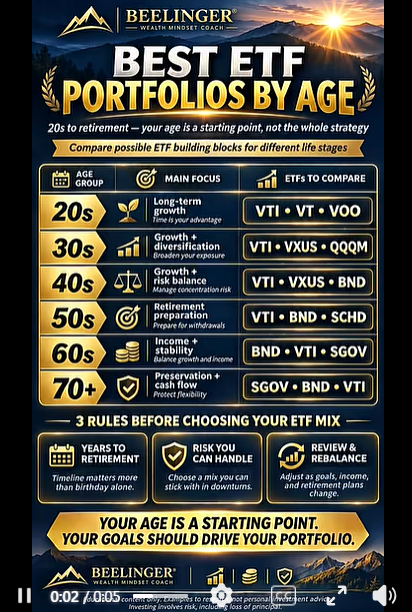
Your age is a starting point, not a rule
A portfolio is simply the investments you own. The big decision is how to divide your money among stocks, bonds, and cash. That choice depends on when you will need the money, how much loss you could handle, and what you are investing for.
Time until you need the money
Money needed in two years should usually be treated differently from money invested for retirement decades away.
Risk you can live with
Stocks can fall sharply. Your mix should be one you can keep through a difficult market, not just a rising one.
Review and rebalance
Over time, some holdings grow faster than others. Rebalancing helps bring your mix back to the percentages you chose.
Is an ETF portfolio the right next step for you?
Your age only tells part of the story. Answer four questions to find out what to learn next. This guide does not recommend securities, score your finances, or collect your answers.
Three ETF combinations that look similar but act differently
Three ticker symbols do not guarantee three independent investments. Look at what you own, where it invests, and what role each fund serves.
VTI + VT + VOO
What you get: Three funds with substantial exposure to the same large U.S. stocks.
Tradeoff: Buying all three may add complexity and make your portfolio more U.S.-heavy than you intended. VT already includes both U.S. and international stocks.
Question to ask: What additional exposure does each purchase add?
VTI + VXUS + QQQM
What you get: Broad U.S. stocks, international stocks, and a Nasdaq-100 tilt.
Tradeoff: QQQM is not another asset class. It adds weight to certain large U.S. companies already represented in VTI.
Question to ask: Do I want extra concentration in these companies?
VTI + VXUS + BND
What you get: U.S. stocks, non-U.S. stocks, and investment-grade U.S. bonds.
Tradeoff: Bonds can still fall in value, and this mix may not cover cash needs, taxes, or every financial goal.
Question to ask: How much of each asset type fits my timeline and ability to take risk?
70+ is not automatically a cash-only portfolio
The infographic highlights SGOV, BND, and VTI as funds to compare. SGOV holds very short-term Treasury bills; BND is a broad bond fund with more interest-rate exposure; VTI is a stock fund. Each serves a different purpose. A retiree's spending plan, guaranteed income, withdrawal needs, and investment horizon matter more than turning 70.
Same age does not mean the same portfolio
Here is why context matters more than choosing a fund from a list.
Saving for a home in three years
This person may need the down payment soon. A stock-heavy ETF mix could drop before the money is needed.
Better question: Which lower-volatility savings options match a three-year goal?
Retirement savings for 30 years
A long timeline gives the person more time to recover from market declines, but does not remove risk.
Better question: What diversified mix can I afford to hold through a downturn?
Retirement with other income
A pension or other reliable income source can change how much investment risk and liquidity someone needs.
Better question: How will I pay for near-term spending while keeping long-term investments appropriate?
Interactive ETF portfolio explorer
Pick an age group and enter an amount. See how a sample VTI + VXUS + BND portfolio could be divided. These percentages are examples for learning, not recommendations for everyone in that age group.
Explore a Three-Fund Mix
Broad U.S. stocks, international stocks, and U.S. bonds
40s: Growth with risk control
Illustrative portfolio: 70% stocks / 30% bonds.
Example only; your financial needs may call for a different mix.
The explorer does not forecast returns, factor in taxes or fees, or determine your suitability for an investment. Dollar amounts are simple arithmetic, not a trade recommendation.
ETF portfolios by age
Our infographic lists ETFs worth comparing at each age. Below, we explain the priority behind each list and show one broad, three-fund allocation to help you understand the stock-to-bond tradeoff.
In your 20s: Long-term growth
You may have decades for your investments to grow. Stock funds can provide growth, but large drops are possible.
What to focus on
Build an emergency fund, avoid high-interest debt, and invest regularly rather than trying to time the market.
ETFs in the infographic
Know the difference: All three hold many of the same U.S. companies. This is a U.S.-stock-heavy comparison, not three separate asset classes.
VTI 60% U.S. stocks · VXUS 30% international stocks · BND 10% U.S. bonds.
This is a simple illustration, not a model you must follow. The graphic's tickers are comparison ideas, not this allocation's exact holdings.
In your 30s: Growth and diversification
Your retirement goal may still be far away, even while near-term costs like housing and childcare compete for cash.
What to focus on
Use a broad mix of U.S. and international stocks; choose a bond level you can stay invested with while balancing living costs in your 50/30/20 budget.
ETFs in the infographic
Know the difference: QQQM tilts toward Nasdaq-100 large companies already represented in VTI. Adding it increases concentration, not broad diversification.
VTI 55% U.S. stocks · VXUS 25% international stocks · BND 20% U.S. bonds.
This is a simple illustration, not a model you must follow. The graphic's tickers are comparison ideas, not this allocation's exact holdings.
In your 40s: Growth with risk control
Your goal is to keep growing while preparing for a shorter investing timeline and potentially more responsibilities.
What to focus on
Review retirement savings, fees, and risk at least once a year, and make sure you capture your full company match with our 401(k) Match Calculator.
ETFs in the infographic
Know the difference: This combination covers U.S. stocks, international stocks, and U.S. investment-grade bonds with less direct overlap.
VTI 45% U.S. stocks · VXUS 25% international stocks · BND 30% U.S. bonds.
This is a simple illustration, not a model you must follow. The graphic's tickers are comparison ideas, not this allocation's exact holdings.
In your 50s: Retirement preparation
A bad market downturn close to your planned retirement date can be harder to recover from, especially before withdrawals begin.
What to focus on
Track your total assets and liabilities in the Net Worth Calculator and build a plan for cash reserves and future withdrawals.
ETFs in the infographic
Know the difference: SCHD is still a stock fund and overlaps with parts of VTI. Dividend payments do not remove market risk.
VTI 40% U.S. stocks · VXUS 20% international stocks · BND 40% U.S. bonds.
This is a simple illustration, not a model you must follow. The graphic's tickers are comparison ideas, not this allocation's exact holdings.
In your 60s: Income and flexibility
You may be approaching retirement or already drawing income. A mix of growth and less-volatile assets can help balance competing needs.
What to focus on
Plan when and how to withdraw from accounts; account for inflation, taxes, and unexpected expenses.
ETFs in the infographic
Know the difference: SGOV holds short-term U.S. Treasury bills and plays a different role than a broad bond fund; neither is a risk-free substitute for cash.
VTI 35% U.S. stocks · VXUS 15% international stocks · BND 50% U.S. bonds.
This is a simple illustration, not a model you must follow. The graphic's tickers are comparison ideas, not this allocation's exact holdings.
In your 70+: Preservation and cash flow
Investment decisions depend more on spending needs, other guaranteed income, health, household circumstances, and legacy goals than age alone.
What to focus on
Keep an appropriate cash reserve for spending and preserve some growth exposure when it fits your goals.
ETFs in the infographic
Know the difference: Short-term Treasuries may support near-term needs, while bond and stock funds have different risks. Allocation still depends on spending horizon.
VTI 25% U.S. stocks · VXUS 15% international stocks · BND 60% U.S. bonds.
This is a simple illustration, not a model you must follow. The graphic's tickers are comparison ideas, not this allocation's exact holdings.
What do these ETF tickers actually mean?
An ETF is an exchange-traded fund. It holds a basket of investments that you can buy and sell in the market. Two funds with different names can still own many of the same stocks.
| ETF | What it generally holds | What to know |
|---|---|---|
| VTI | Broad U.S. stock market | Includes large, mid, and small U.S. companies. |
| VT | U.S. and international stocks | Already includes much of VTI and VOO. |
| VOO | Large U.S. companies in the S&P 500 | Overlaps heavily with the large companies in VTI. |
| VXUS | Stocks outside the U.S. | Can diversify a U.S.-only stock portfolio. |
| QQQM | Nasdaq-100 companies | Tilts toward large nonfinancial Nasdaq-listed businesses; overlaps with broad U.S. funds. |
| SCHD | Dividend-focused U.S. stocks | Still carries stock-market risk. Dividends are not guaranteed. |
| BND | Broad U.S. investment-grade bonds | Can lose value when interest rates or other conditions change. |
| SGOV | Very short-term U.S. Treasury bills | Usually has less interest-rate sensitivity than longer-duration bonds; yield changes. |
Three rules that matter more than your birthday
1. Know your timeline
Set aside money for upcoming bills and near-term goals. Your investment timeline should match the date you expect to use the money.
2. Choose risk you can handle
Think about what you would do if your stocks fell 30% or more. A plan you abandon during a decline may not be the right plan for you.
3. Check your mix
Review your allocation at a regular interval, such as once or twice a year, and consider rebalancing if it drifts from your target.
ETF investing questions, answered simply
Is there one best ETF portfolio for my age?
No. Two people the same age may have very different goals, savings, pensions, debt, and risk tolerance. Age helps you begin the conversation, but does not determine the answer.
Do I need exactly three ETFs?
No. One broadly diversified fund may meet your goal. Three can be a simple way to separate U.S. stocks, international stocks, and bonds, but the number of fund tickers alone does not measure diversification.
Is a higher dividend ETF safer?
Not necessarily. Dividend-paying stock funds still move with the stock market, and companies can cut dividends. Focus on total return, diversification, costs, and your spending needs rather than yield alone.
Should I sell all stocks when I retire?
Not automatically. Some retirees may need stocks for long-term growth and inflation protection, while keeping sufficient cash or bonds for shorter-term spending. Your withdrawal plan and other income sources matter.
How often should I rebalance?
A regular check every six or 12 months is one common approach. Some investors rebalance when their allocation moves outside a preset band. Taxes and trading costs can affect the decision.
Are the percentages a recommendation to buy VTI, VXUS, and BND?
No. They are hypothetical illustrations of asset allocation. They do not account for your full financial situation, and they are not forecasts of future returns.
Sources and further reading
- Investor.gov: Asset Allocation and Diversification
- Investor.gov: Beginner's Guide to Asset Allocation, Diversification, and Rebalancing
- Vanguard: ETF descriptions and fund information
- iShares: SGOV fund information
- Schwab: SCHD fund information
Beelinger editorial note: Example allocations and fund comparisons are educational, not individualized investment advice. Investing carries a risk of loss. Funds can change their holdings, expenses, policies, and yields. Check official fund materials before investing. No historical or projected return figures are used in this guide.
By Beelinger Editorial Team · Updated November 23, 2026